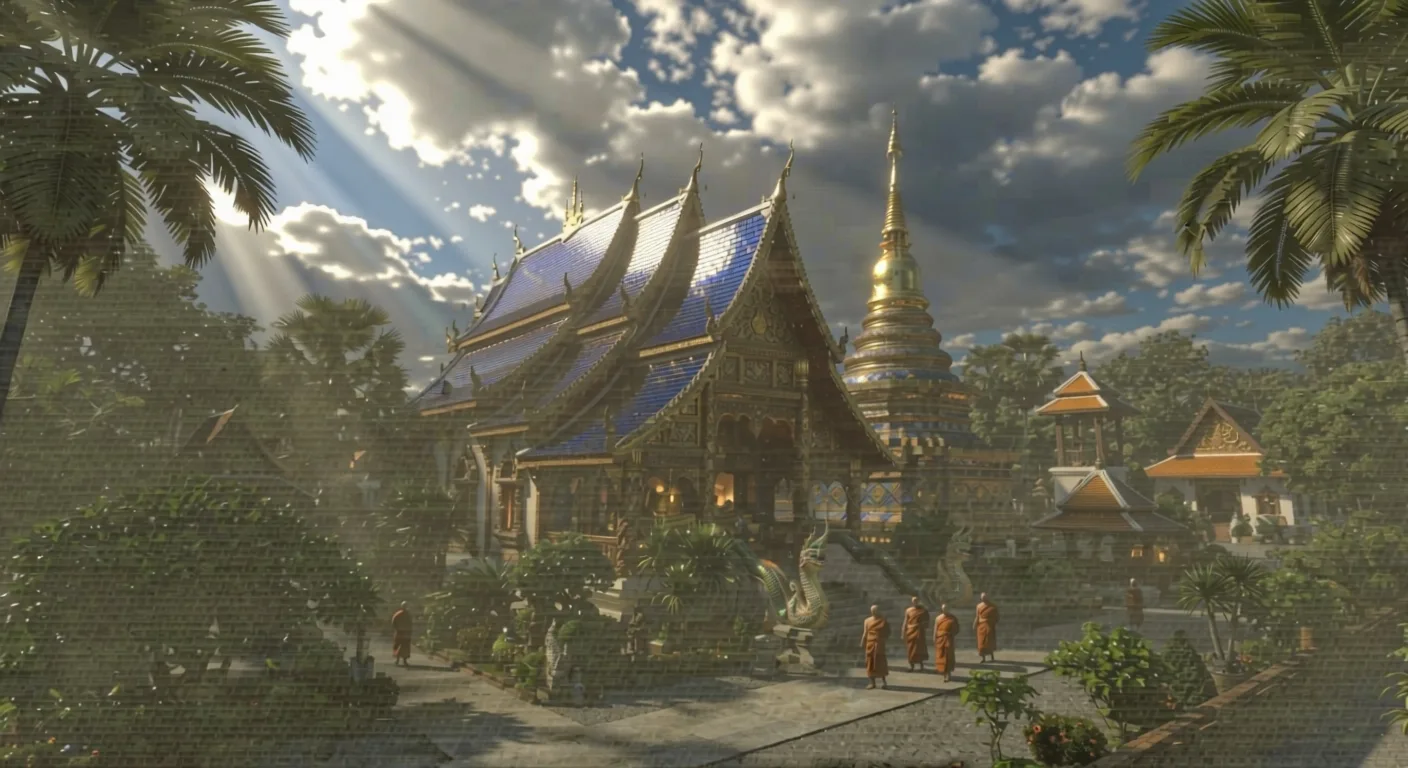
Wat Pa Suttawat: A Sacred Centre of the Thai Forest Tradition
Wat Pa Suttawat (วัดป่าสุทธาวาส) is one of the most important forest monasteries in Sakon Nakhon Province, northeastern Thailand. The temple is particularly revered because it was the place where Luang Pu Mun Bhuridatta (หลวงปู่มั่น ภูริทัตโต), one of Thailand's most influential meditation masters, spent the final period of his life and passed away in B.E. 2492 (1949).
Today, Wat Pa Suttawat remains an important destination for Buddhist devotees, students of meditation and visitors interested in the history of the Thai Forest Tradition. The temple preserves a museum dedicated to Luang Pu Mun, his relics and monastic belongings, as well as memorial structures associated with other important forest monks.
The temple's significance therefore extends beyond its buildings. Wat Pa Suttawat represents a living connection to a major period in modern Thai Buddhist history and to a lineage of meditation masters whose teachings continue to influence Buddhist practice throughout Thailand.
The History of Wat Pa Suttawat
The history of Wat Pa Suttawat is closely connected with the development of forest meditation practice in Sakon Nakhon.
Local administrative records state that in B.E. 2469 (1926), Phra Ajahn Sao Kantasilo and Phra Ajahn Mun Bhuridatta stayed during the rains at a forest dwelling known as Samnak Pa Ban Bak. The site later developed into Wat Pa Suttawat after local residents invited the two respected meditation masters to stay and practise in the area.
This early association with Ajahn Sao and Ajahn Mun is highly significant because both monks played important roles in the development of the Thai Forest Tradition.
Over subsequent decades, Wat Pa Suttawat developed into an important centre of Buddhist practice and became permanently associated with Luang Pu Mun's final years.
Luang Pu Mun Bhuridatta
Luang Pu Mun Bhuridatta, also known as Ajahn Mun Bhuridatta, is widely regarded as one of the most influential meditation masters in modern Thai Buddhism.
He was born on 20 January B.E. 2413 (1870) in Ubon Ratchathani Province. After entering the monastic life, he devoted himself to Buddhist study and meditation and became particularly associated with the austere practices of the forest tradition.
Luang Pu Mun spent many years travelling through forests, mountains and remote regions, practising meditation and observing traditional dhutanga disciplines.
His approach emphasised disciplined monastic conduct, meditation, mindfulness and direct investigation of the mind according to Buddhist teachings.
Over time, many monks became his students and followers. Several later became renowned meditation masters themselves, establishing a broad lineage of teachers associated with what is now widely recognised as the Thai Forest Tradition.
Luang Pu Mun and the Thai Forest Tradition
The Thai Forest Tradition places strong emphasis on meditation, monastic discipline, simplicity and direct practice.
Forest monks traditionally seek secluded environments where they can devote themselves to meditation and reduce worldly distractions. Practices may include walking meditation, sitting meditation, mindfulness, contemplation and the observance of traditional monastic disciplines.
Luang Pu Mun became one of the most influential teachers in this tradition. His teachings emphasised the importance of practising the Buddha's teachings directly rather than treating Buddhism merely as an academic or intellectual subject.
His approach attracted many dedicated disciples and helped establish a network of forest monasteries throughout northeastern Thailand and beyond.
Luang Pu Mun's Final Years
After decades of travelling and practising in forests and remote areas, Luang Pu Mun spent his later years in northeastern Thailand.
During the final years of his life, he became increasingly revered by monks and lay devotees who travelled to seek his guidance and teachings.
His health eventually declined, and he came to Wat Pa Suttawat in Sakon Nakhon during the final period of his life.
Luang Pu Mun passed away peacefully at Wat Pa Suttawat on 11 November B.E. 2492 (1949), at the age of 79 by Western reckoning. His passing marked a major moment in the history of the Thai Forest Tradition.
The temple subsequently became one of the principal places of pilgrimage for devotees wishing to honour his memory.
The Passing of Luang Pu Mun at Wat Pa Suttawat
The place associated with Luang Pu Mun's final moments has been preserved as an important sacred area within the temple.
The present ubosot stands on the site traditionally associated with the kuti where Luang Pu Mun passed away. The building is also connected with the cremation ceremony held following his death.
This connection gives the building exceptional importance to devotees. It is not simply a religious structure but a place associated with the final chapter of the life of one of Thailand's most revered forest meditation masters.
The Luang Pu Mun Bhuridatta Museum
One of the most important attractions at Wat Pa Suttawat is the Luang Pu Mun Bhuridatta Museum.
The museum was created around the area associated with Luang Pu Mun's final period and preserves important objects connected with his monastic life.
Visitors can see a life-size representation of Luang Pu Mun seated in meditation, together with relics and examples of his monastic belongings.
The collection includes objects associated with his daily life and traditional monastic practice, such as his alms bowl, robes, religious texts and other personal items.
These objects are valuable because they provide a tangible connection with the simple lifestyle of a forest monk.
Luang Pu Mun's Relics
The museum and memorial areas at Wat Pa Suttawat preserve relics associated with Luang Pu Mun, which are treated with deep reverence by Buddhist devotees.
Within Thai Buddhist devotional culture, the relics of highly respected monks may be regarded as reminders of their spiritual practice and achievements.
The preservation of Luang Pu Mun's relics at Wat Pa Suttawat has strengthened the temple's role as a pilgrimage destination for those wishing to honour his memory.
It is important, however, to distinguish religious interpretations of relics from scientific claims. Their spiritual significance belongs to the Buddhist devotional tradition surrounding the revered monk.
The Simplicity of Luang Pu Mun's Monastic Life
One of the most meaningful aspects of the museum at Wat Pa Suttawat is its emphasis on Luang Pu Mun's ordinary monastic belongings.
His robes, alms bowl and other simple possessions illustrate the disciplined lifestyle associated with the forest tradition.
For Luang Pu Mun and his disciples, simplicity was not merely an aesthetic preference. It supported the broader Buddhist objective of reducing attachment to material possessions and focusing attention on meditation, ethical conduct and wisdom.
Visitors can therefore learn about the Thai Forest Tradition not only through written biographies but also through the humble objects that accompanied the monk throughout his life.
Chantasan Chedi Anusorn
Another important structure within Wat Pa Suttawat is the Chantasan Chedi Anusorn, also associated with the revered forest monk Luang Pu Louis Chandasaro.
The structure was created as a memorial and museum dedicated to Luang Pu Louis. According to local administrative information, the construction was undertaken in accordance with a royal initiative, with an initial design provided by King Bhumibol Adulyadej.
The purpose was to create a chedi at Wat Pa Suttawat where Luang Pu Louis could be commemorated near the relics of Luang Pu Mun.
The memorial contains an image of Luang Pu Louis together with objects associated with his monastic life.
Luang Pu Louis Chandasaro
Luang Pu Louis Chandasaro was an important disciple within the lineage associated with Luang Pu Mun.
He became respected as a forest meditation master in his own right and continued many of the principles of disciplined practice associated with his teacher.
His presence within the history of Wat Pa Suttawat demonstrates the importance of teacher-student succession within the Thai Forest Tradition.
The temple therefore commemorates not just one monk but a broader lineage of meditation masters who helped preserve and transmit forest Buddhist practice across generations.
Wat Pa Suttawat and the Lineage of Luang Pu Mun
Luang Pu Mun's influence can be seen throughout northeastern Thailand through the many monks who studied under him or were influenced by his teachings.
Among the renowned practitioners associated with his lineage were monks such as Luang Pu Fan Acharo, Luang Pu Louis Chandasaro and other major forest meditation teachers.
These monks established monasteries, trained disciples and helped spread meditation practice throughout Thailand.
Wat Pa Suttawat consequently forms part of a much larger network of temples connected with the history of the Thai Forest Tradition.
Wat Pa Suttawat and Sakon Nakhon
Sakon Nakhon has developed a particularly strong association with Thai forest meditation.
The province contains numerous temples connected with important meditation masters, making it an important destination for people studying Thai Buddhist practice and the history of forest monasteries.
Wat Pa Suttawat occupies a central position in this heritage because of its direct association with Luang Pu Mun and his final years.
The temple's location near the centre of Sakon Nakhon also makes it accessible to visitors exploring the city's Buddhist and cultural heritage.
Wat Pa Suttawat and Thai Buddhist Amulet Culture
Wat Pa Suttawat is also relevant to the study of Thai Buddhist amulets and sacred objects associated with Luang Pu Mun.
Luang Pu Mun's name and image have appeared on various devotional objects produced by temples and devotees, particularly after his death. Such objects may include medallions, portrait images and other forms of Buddhist devotional material.
For devotees, these objects may serve as reminders of Luang Pu Mun's teachings and spiritual example.
For collectors, objects connected with Luang Pu Mun and the Thai Forest Tradition represent an important part of twentieth-century Thai Buddhist history.
Collectors should nevertheless distinguish between objects actually produced or consecrated at Wat Pa Suttawat and later devotional issues produced elsewhere. Identification should consider the exact year, temple, monk, material, design, inscriptions and documented provenance.
Luang Pu Mun Amulets and Devotional Beliefs
Devotees may traditionally associate Luang Pu Mun's image and sacred objects with qualities such as spiritual encouragement, protection, mindfulness and connection with the monk's teachings.
Such associations belong to Thai Buddhist devotional culture and should be understood as matters of faith rather than scientifically established supernatural effects.
The historical and cultural significance of Luang Pu Mun devotional objects can nevertheless be studied independently through their relationship with the monk, temple, forest tradition and Thai Buddhist art.
The Buddhist Meaning of the Forest Tradition
The forest tradition represented by Wat Pa Suttawat emphasises a return to fundamental Buddhist practice.
Rather than focusing primarily on material wealth or elaborate surroundings, forest monks traditionally emphasise ethical discipline, meditation, mindfulness and wisdom.
Luang Pu Mun's teachings encouraged practitioners to examine their own minds and to develop understanding through sustained practice.
This emphasis helps explain why the simple environment associated with the monk remains meaningful to devotees. The physical simplicity of the forest monastery reflects a broader spiritual ideal of reducing distraction and cultivating inner discipline.
Wat Pa Suttawat as a Place of Pilgrimage
Wat Pa Suttawat attracts Buddhist devotees, meditation practitioners, Thai amulet collectors and visitors interested in the history of Luang Pu Mun.
Many visitors come to pay respects at the museum and memorial areas, while others visit to learn more about the Thai Forest Tradition.
The temple provides an opportunity to encounter both the historical and spiritual aspects of Luang Pu Mun's legacy.
For Buddhist practitioners, visiting the temple can also provide an opportunity for quiet reflection and contemplation of the teachings associated with the forest tradition.
Visiting Wat Pa Suttawat
Wat Pa Suttawat is located in Mueang Sakon Nakhon District, Sakon Nakhon Province, northeastern Thailand.
Visitors should remember that the temple remains an active Buddhist monastery and should dress modestly and behave respectfully.
When entering sacred buildings or museum areas, visitors should follow the instructions of temple authorities. Shoes may need to be removed in certain areas, and quiet behaviour is particularly appropriate around Buddha images, relics and meditation spaces.
Photography should also be undertaken respectfully, especially when photographing relics, sacred objects or areas used for religious practice.
Wat Pa Suttawat and Buddhist Heritage Preservation
The preservation of Wat Pa Suttawat demonstrates the importance of protecting not only historic buildings but also the objects and traditions associated with influential Buddhist teachers.
Luang Pu Mun's museum preserves material evidence of his monastic lifestyle, while the temple's memorial structures maintain the connection between the site and the forest meditation lineage.
Such preservation allows future generations to study the history of Thai Buddhism through both written records and physical heritage.
The temple therefore functions simultaneously as a place of worship, a memorial, a centre of Buddhist education and an important heritage site.
Why Wat Pa Suttawat Matters to Thai Buddhist Heritage
Wat Pa Suttawat is significant because it preserves one of the most important chapters in the history of modern Thai Buddhism.
Its association with Luang Pu Mun Bhuridatta connects the temple with the development of the Thai Forest Tradition and with a generation of meditation masters whose influence extended throughout Thailand.
The Luang Pu Mun museum preserves his relics and personal belongings, while the memorial to Luang Pu Louis Chandasaro demonstrates the continuation of the teacher-student lineage.
The temple therefore represents the continuing relationship between Buddhist meditation, monastic discipline, teacher lineage, community devotion and Thai cultural heritage.
Conclusion
Wat Pa Suttawat is one of the most significant forest monasteries in northeastern Thailand and an essential site for understanding the legacy of Luang Pu Mun Bhuridatta.
The temple's history began to develop as a forest practice site in the early twentieth century and became permanently associated with Luang Pu Mun during the final period of his life. He passed away at Wat Pa Suttawat in B.E. 2492 (1949), making the temple one of the most important places associated with his life and legacy.
The Luang Pu Mun Bhuridatta Museum, his preserved relics, monastic belongings and memorial structures allow devotees and visitors to encounter the history of one of Thailand's most influential forest meditation masters.
The temple's connection with Luang Pu Louis Chandasaro further demonstrates the importance of teacher lineage and the continuing transmission of forest meditation practice.
For devotees, Wat Pa Suttawat is a place of reverence and spiritual reflection. For students of Buddhism, it is an important centre for understanding the Thai Forest Tradition. For collectors, it provides an essential historical connection to Luang Pu Mun and the sacred objects associated with his legacy.
Above all, Wat Pa Suttawat stands as a lasting reminder of the Buddhist values of simplicity, discipline, meditation, mindfulness and wisdom that defined the life and teachings of Luang Pu Mun Bhuridatta.